


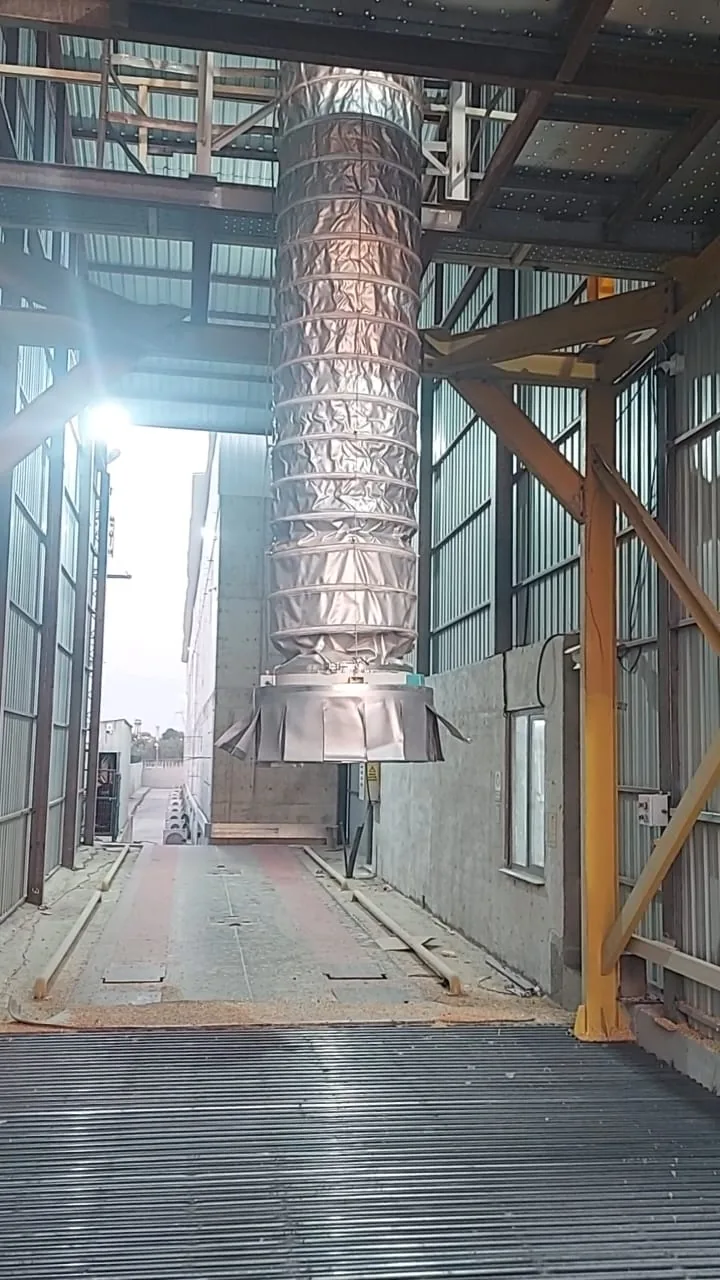
Telescopic Loading Spout
The telescopic loading spout is an extendable, bellows-type loading device that transfers product from a silo or hopper into trucks, trailers and ship holds without dust emission. Its height-adjustable structure minimises spillage and dust.
What Is a Telescopic Loading Spout and How Does It Work?
The telescopic spout consists of nested conical segments and an outer bellows. Lowered to vehicle height by a winch or motorised drum, the spout transfers the product to the vehicle through a closed channel; the dust generated inside the bellows can be drawn off through an optional aspiration connection. After loading, the spout retracts upward to free the vehicle exit.
Key Features
- Dust-free, spill-free loading thanks to the closed bellows
- Extension length adjustable to vehicle height
- Manual winch or motorised drum drive options
- Automatic lift with level sensor and connection to the dust collection system
Applications
- Truck loading silos and dispatch points
- Port and ship loading lines
- Bulk product dispatch at feed and flour mills
Integration with Plant and Automation Systems
The spout works together with the truck loading silo, bulk weigher and dust collection system. On motorised models the raise/lower movement and level sensor are wired to the automation panel so the loading process is controlled.
Engineering and Selecting the Right Product
Loading height and vehicle type, target loading capacity, product type and dust collection needs determine the spout diameter, extension length, drive type and aspiration connection.
Frequently Asked Questions
When engineered with the appropriate extension length and capacity, it can be used for loading ship holds.
The closed bellows keeps the dust inside; where required, the spout is connected to the dust collection system for aspiration.

30-Year Warranty
The galvanized material used is long-lasting

High Galvanized Coating
Durable and high-quality coating

Static Design
Correct static design through engineering analysis